Love, Forever… In A Tiny Prison Town

When we choose to pay attention to our heart, our inner sense of self, and our emotions of love, the universe listens and often sends messages of affirmation. Last weekend, I spent 3 days and 3 nights in 3 cities: 2 film screenings, 2 lectures, 3 social dinners, and 2 prison visits. Big events in big cities. But the biggest events in my mind were my prison visits which took place in a tiny prison town 2 hours south of Dallas – Tennessee Colony, Texas (population 300). The town is home to 5 state prison units – Beto, Coffield, Gurney, Michael, and Powledge.

One loved one, like a little brother to me,  incarcerated at the Michael Unit, finally got parole approved (after 11 rejections) last month! He’s done 26 years, sentenced at age 18 for a crime he foolishly committed at 16. We are thrilled to have him come home soon, hopefully this June when he completes his reentry courses. While he was incarcerated, he earned 2 associates degrees and is ready to find work to be a productive member of society. I am so excited he will get a new chance at life after receiving a life sentence when he barely turned 18 years of age. He will have challenges, but his determination is evident, and we are here to support him all along the way.

My other loved one, an old flame, my first love, is at the Beto Unit, having served 22 years so far of a 60 year sentence for a crime he didn’t commit. Wrongful convictions of vulnerable and/or indigent people are common. Heartbreaking, to say the least. When I learned of his sentence, he was 24 and I was 23. I cried for a long time. His family cried then and still cries now. On occasions when I feel melancholy, I still cry. The pain of a wrongful conviction never heals. We just do what we have to do to endure. For a long period of time, we lost touch – he withdrew into his prison life, and I forged on with my own path in life that required me to shed my old life, which meant shedding my old associations. Seven years ago, his sister reached out to me and encouraged me to write him. I was scared. I didn’t know what to write. As a foolish person, I only thought of myself, and not of him.  His sister told me, “He would be so happy to hear from you.” But so many years had passed. Even though he crossed my mind now and then, it was always sad thoughts. I didn’t want to cry. I didn’t want to be sad. I let the catchphrase of “the past is the past, leave it there” control my attitude. So I didn’t write him.

In the last several years, I returned to the roots of my past, revisiting memories of the experiences and the kinds of people who are a deep part of who I am – they are what I am grounded in. In the last several years, I had the opportunity to participate in social activism against the injustice of private prisons. I had the opportunity to mentor and support formerly incarcerated students on campus. I had the opportunity to learn from my students and my colleagues that I can revisit my past as a way to heal, rather than a pathway to pain and suffering. When we screened the film, “Life After Life”, I embraced the hopes and wishes for those who have been in for so long. And finally, it was through my memoir writing last year that I decided to write him again. When I was forced to confront my past in order to write about it, the memories and emotions were so powerful that I felt the need to reconnect. And so I wrote him. And he wrote me back. The first line of his first letter, “It is funny how your letters always seem to find me in the darkest places of my life, as I always hoped that you would write me eventually one day.” We have resumed our friendship and our connection, and it is a beautiful thing. One of the most beautiful things I have in my life right now.

It is not often that I get a chance to visit, but when I do, I walk away with the kind of gratitude that is rare. As I hustle and bustle through life, time is something I know is valuable. But the time that you get during a prison visit, believe me, you truly understand that it’s fucking valuable. The first time I visited, I was surprised how scared I was when driving up to the unit. The chain linked fence, the big concrete walls, the barbed wire on top of the walls, the large bright lights, and of course, the tower with the guard and the gun. Very intimidating. After going through the security measures, I sat in the visitation room waiting for him to arrive. As he walked out the door and along the corridor, I saw him through the glass – it was bizarre that I felt so happy and also utterly devastated at the same time. Happy to see him after over two decades had passed, and devastated that he had spent that time locked up for something he didn’t do.

There is no doubt that the time we get to visit is precious. When the guard comes by to tell you there’s 5 minutes left, time becomes even more treasured. It is bittersweet. Saying good bye makes me sad, so I say “Until next time.” And so, last weekend, we said “Until next time,” and I left the Beto Unit feeling happy and devastated.

I had to grab a quick fast food lunch to make it in time for my Sunday evening film screening in Dallas. I decided on Burger King – a nostalgic joint, the choice of my childhood meals when my parents wanted to treat us to something nice. As a small framed kid, I was always proud I could finish a whole Whopper. I ordered a Whopper and onion rings because I never liked their fries. As I savored my rare fast food meal, I thought of the resilience of my loved one who is incarcerated with no parole eligibility for another 8 years.

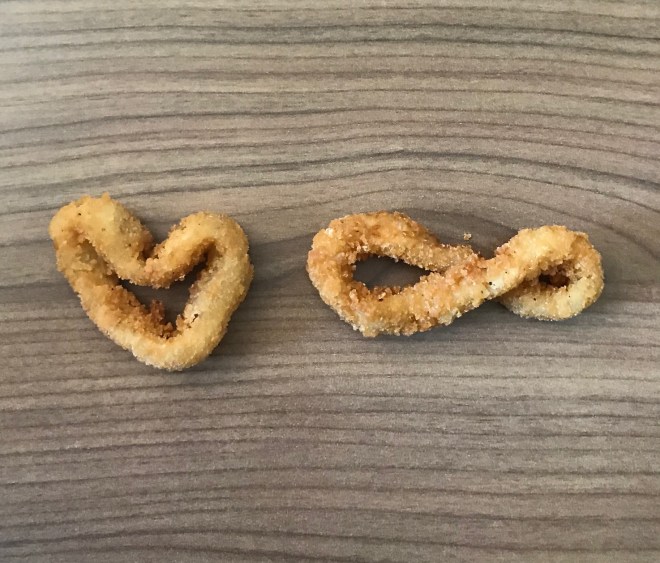
During our visit, he was cheerful, positive, and philosophical. He seemed lighthearted, asked questions with depth, and responded to my questions with the kind of answers that left me in awe of his worldliness. How could someone who has been trapped inside prison walls for so long have such a broad and deep lens on the world outside of this concrete hell? The answer is that he reads. A lot. I reflected on his circumstance, and I thought to myself, “How he has been able to maintain such a grateful disposition and hopeful heart?”  To survive a maximum security unit, he is sometimes forced to embody a hardened persona, being entrenched in the harshest and most violent conditions as an inmate at one of the toughest units in the state. Yet, after all these years, he can still express love, kindness, generosity, and gratitude to his family and loved ones. Rather than choose darkness and hate, he chooses love and hope. I am in awe of his strength and courage. And so, I learn from him and am reminded from him, that I choose love and hope for myself and everyone else. And especially, I choose love and hope for him, too, even though his circumstance is bleak. If he is ever released, he has a detainer for deportation. The current administration is determined to deport him. In one of his writings, he expresses his plight, “I am terrified to think that my family escaped Vietnam only for me to return there almost 50 years later, in handcuffs. I hope the land of my father feels that I am redeemable. But to be honest, anywhere is better than to live without hope and the feel of sunshine on my face.” No matter where he is or will be, I will always love and have hope for him. This small prison town made me sad, but his ability to have perpetual love and hope reminds me to do the same.  When I stared at the pile of onion rings I had remaining, I noticed that the universe was listening to my thoughts and expressing the essence of his being. In the pile of mostly circle shaped onion rings were 2 that looked like this… Love, Forever.

IMG_3009

Let’s Talk About Race

Let’s dialogue about race. It’s an uncomfortable conversation for most of us. And anytime the topic is raised, the stress level of the parties involved surely go up a measure or two. With my last entry, I got some critical responses of which I was called out for calling out my Father as a racist. What kind of person would call out her own Father and an entire group of people (her own people, Vietnamese Americans) as racist?!  Ummm… an honest one?

But allow me to be clear about how I understand race as a sociologist and as a person of color. I’m not here to appease anyone or to lecture anyone. My hope is that it provides more perspectives for all of us to consider in how we think or feel about race as a concept that is very much alive in the American social fabric.

To begin, there are a lot of well-meaning people who I believe really do not want to see race. You know these people and you may be one yourself.  You want to see the good in everyone. You love those viral videos of black and white kids playing in the front yard together, meaning they live in the same neighborhood with each other, and their parents have pot luck meals together with a multicultural menu that would make delicious ingredients for the hip, fusion restaurants lining the streets of mixed neighborhoods that have somehow thwarted gentrification. You genuinely want everyone to get along, and you strive to treat everyone the same. But ask yourself, what are you ignoring on a larger scale when you see race only through what you hope and wish for?

Then there are the outright racists. These people are the polar opposite of the I Don’t See Race folks. They are the people we see on the news and documentaries about White Supremacists, the KKK, and White Nationalists. They either don KKK hoods or sport khaki pants, red hats, and American flag themed apparel. Their favorite mottos are “White Power”, “White Pride”, and “White Genocide”. These folks are angry. They see a race war coming, and they’re preparing themselves for the race apocalypse. The takeover by non-white folks will be defended to the death. The two images I’ve described reflect a white supremacist of the past and a white supremacist of the present. The white supremacists of the past are easier to write off with their kooky Klan hoods, but the white supremacists of the present are almost alluring. Think Richard Spencer. He is clean cut, sports suits and ties, articulate, and he holds conferences (instead of cross burnings). He presents a panache version of the white supremacist.  Central to the major difference that these folks have from the well meaning I Don’t See Race folks is that white supremacists not only see race, they see race as central to their identity. Race isn’t just a side thing, it’s a core central thing to who we are and how we should live our lives. And to them, clearly, the white race is supreme and superior.

Somewhere in between these two polar opposites are a variety of folks who understand race in some fashion or form. My intention is not to get us into a discussion about this complexity. There are tons of books and stories out there that show how complex the topic of race was and is and will be. My intention is to try to simplify how I think of race in a way that makes it easier for me to live within a society that is so very complicated. Let me start by stating that racism and being racist is about POWER. It’s as simple as that. If you can wrap your head around the idea that RACISM IS ABOUT POWER, you’re off to a good start for simplification.

Let us use my Father as an example, because it’s a real, and not hypothetical one, and because it can hopefully clear the air with folks who are uncomfortable with me calling him out as racist AND with folks who wonder how I can still love my Father unconditionally if I truly believe he is racist.

My Father, like all of us, has prejudices. I, myself, have prejudices. If you say you don’t have any prejudice, you’re in denial. You do. And these prejudices are not a one size fits all kind of prejudice. There’s a concept in the social sciences called the Social Distance Scale where USC researcher, Emory Bogardus, outlines for us in measurable ways how close or far we feel about people who are different from us. His scale empirically measures people’s “willingness to participate in social contacts of varying degrees of closeness with members of diverse social groups, such as racial and ethnic groups. The scale asks people the extent to which they would be accepting of each group.” A lower score means one is willing to have the closest social distance to someone different while a higher score means one is setting themselves furthest from someone different. Here are the categories:

As close relatives by marriage (i.e., as the legal spouse of a close relative) (score 1.00)

As my close personal friends (2.00)

As neighbors on the same street (3.00)

As co-workers in the same occupation (4.00)

As citizens in my country (5.00)

As non-citizen visitors in my country (6.00)

Would exclude from entry into my country (7.00)

If you ask my Father about black men, he would rate himself as 2. Remember I said he didn’t want me to marry a black man? He would not score 1 for black men. But his neighbor and close personal friend is a black man. My Father has helped him on many occasions and has had them over to the house many times. He’s worked and gotten along fine with black people. He would not exclude black men in any way, except for marrying me – I know in his mind he thinks, “Who would want to marry his hard headed, argumentative, bossy daughter anyway?”

Does this make him racist? Where does power come into play? If I listened to him as my authority figure and denied black men a chance to date, court, woo, marry me, then my Father has won. It would be a racist situation because I’ve allowed my Father to have power over my decision making, which then would in turn deny a man based on the color of his skin. Well, too bad, Dad, you lose on this one. Funny how things work out, as he’s not objected to the current guy in my life who is bi-racial, Vietnamese and Black! I laugh out loud at this situation because how is my Father gonna deny this dude? He’s half Viet after all! Even though he’s half black. But it doesn’t matter what my Father thinks. With my decision, I have taken his power away. So I’ll backtrack from my last blog and state that my Father has some prejudice against black men, but I’ve taken away his power to deny me a black man if I should so choose to be with one.

If my Father was a judge, and his job was to certify marriages, and he felt that black men should only marry black women, and he exerted his power to deny an interracial couple their marriage, then he would be racist, like Judge Keith Bardwell from Louisiana did. Judge Keith Bardwell has a prejudice, the same one as my Father does, but Judge Bardwell is racist, enacting his authority and power over other people. I don’t worry about my Father’s prejudice because, truth be told, he doesn’t have a lot of power in society. He’s just an immigrant who worked hard to provide for his family. Luckily his prejudiced beliefs did not stick with me. Now…imagine if a whole bunch of people thought like my Father were able to pass on their beliefs to the next generation, and the next generation practiced this belief. Would that matter? This is where the issue of preference comes in. Are you racist if you prefer to be with someone of your own race? Or what if you prefer someone not of your own race (for example, those Asian women who say they don’t date Asian men)? I would not put this on the level of racism. But the reason why it’s important to point these things out and dissect them is because it begs the question… when does this become a problem, if it does at all? Is there a tipping point when this example becomes racist?

What if my Father and those who thought like him voted on a law that would not allow interracial marriages (this law was real before, it was called miscegenation laws). That’s power. That’s where he and they have power. Power comes in numbers. This is how prejudiced ideas become racist practices and policies in a society. And this is where the panache white supremacists are dangerous. They have money, they are educated, and they are mobilizing themselves in ways that bring power to the table. We should not tolerate these views. We have to keep prejudice in check.

To keep prejudice in check, we need to understand and dispel racial/ethic stereotypes because this is often where prejudice comes from. If we don’t address prejudice, we allow the opportunity for those prejudices to become forms of power. And that’s racist. Individuals can be racist when they have power over others. Institutions can be racist when they operate in a way that purposely harms certain groups (think Jim Crow laws). And structures can be racist when they operate in a way that seems to be neutral but actually harms certain groups over others (the war on drugs, redlining in real estate, voter suppression, etc).

For me, I’m less occupied with my Father’s prejudice than I am with society’s individuals, institutions, and structures that enact prejudice through power and will over others. That’s the racism I’m concerned with. Fred L. Pincus wrote an essay that is easily digestible and helps explain how discrimination comes in many forms. In the essay, he provides examples of discrimination at the individual level, institutional level, and structural level. It is through this lens of power that prejudice becomes racist. In this way, Pincus argues that it’s not possible to have reverse racism at the institutional and structural level. At the individual level, unless someone has power over another, it’s just plain prejudice. On a macro level, the power structure of American society is white (and male to be clear about sexism in our society). If you look at the people in power, not just individuals like Oprah Winfrey or Jay Z and Beyonce, the vast amounts of power in wealth, in politics, in corporate leadership, in government decision making – it is white male dominated. So while individuals who are white can be treated unfairly because they’re white, it is a far less likely scenario than it is for someone non-white. White people have never been banned from voting (white women have). White people have never been banned from owning land (white women have). White people have never been banned from getting a higher education (white women have). White people have never been banned from military service (white women have). Do you see a pattern here? It is no wonder then, that white, college educated women (who are awaken to this historical prejudice turned sexism through power over them) socio-politically align themselves with minorities. A recent poll demonstrates this phenomenon.

IMG_1400.PNG

And while the argument can be made that those laws banning minority individuals and women from equality don’t exist anymore, don’t forget the legacy of those laws AND that there are new policies and practices today that pretend to be neutral but empirically affect women and minorities negatively. In some cases, like the War on Drugs policy, there is evidence that the negative effect on racial minorities is an intentional one. The War on Drugs and Mass Incarceration is an example of a neutral policy (drug enforcement) that has had more of a negative effect on black men, and recently black women, than most anyone else. Do black people use and become addicted to illicit drugs more than other groups? Not so, according to American Addiction Centers – a comprehensive, research based drug treatment network that establishes there is no scientific claim to race based drug addiction. The center’s publications further informs us about the role of race in addiction with compelling evidence of the War on Drugs as President Nixon’s assault on the Civil Rights Movement. Nixon, was no doubt, a racist. He used his power to exert and enforce his ill will and prejudice, destroying entire communities and generations of minorities.

And that is why, my friends, we MUST VOTE! Otherwise, we end up with people in power who have prejudices that can be turned into discrimination. If you think you’re not racist, and you hope for your dreams of equality and equity some day, you will never have it if you don’t vote for your hope. White people in general are not the problem. Prejudiced Asian people are not the problem. Anybody, regardless of the color of their skin, who has prejudice and is in power, and uses that power to enforce their ideals of discrimination – these people are the problem. Do not allow them their power! Vote!

My Road Trip To Mississippi With 5 Trump Supporters

Believe me, this was not something I expected. But sometimes life has a strange way of converging various aspects of experiences into times and places which I find intriguing enough to share. Two months ago, my Dad mentioned that he was going to attend a reunion of his flight school and see his flight instructor for the first time in 47 years. In 1971 he was a member of the Republic of Vietnam Air Force (South Vietnam) and was selected for pilot training by the USAF in the United States. He trained at Randolph Air Force Base in San Antonio, Texas, and Keesler Air Force Base in Biloxi, Mississippi. I was intrigued by his reunion event and available to attend since I’m on sabbatical. It’s a part of my family’s history, and revisiting this part of my past would be a rare opportunity. It would surely allow for some deep reflection on stories to be written in my memoir. The event was held Thursday, October 25, at Keesler Air Force Base. I flew to Houston on Tuesday, October 23, and the next morning got in a van with Dad, Mom, 2 of Dad’s Vietnamese pilot buddies also attending the reunion, and the wife of one of those pilot buddies.

It started off quite pleasantly. I knew one of his buddies well, Mr. Tong. Every time we see each other, Mr. Tong teases me about how sad he is that I rejected his son as a suitor. He still refers to me as “dau huc” (missed out daughter in law). I met Mr. Thanh and his wife for the first time. They met my parents through another one of my Dad’s pilot buddies. By the time we got to New Orleans, LA, we took a cool detour through the Lake Pontchartrain Bridge – the world’s longest bridge over continuous water (23.83 miles). As we passed the Mississippi state line, I started to notice the confederate flag flying over various sites. By the time we got to Biloxi, the flag was everywhere. We were near the hotel by Keesler Air Force Base when we passed the museum of Jefferson Davis’ home – he was the first and only President of the Confederate States from 1861-1865. The home was a mansion even in today’s standards, with a distinct plantation style architecture. There were several modern mansions along the coast of Biloxi that undoubtedly maintained the plantation structure and had tall, old trees on the lawn, facing vast water views of the Gulf of Mexico.

My emotions turned weary as the plantation homes and the confederate flag conjured up thoughts of the harsh struggles, devastations, and deaths from the era of slavery – and these struggles, devastations, and deaths that still happen now through slavery’s legacy. The fancy mansions and resort style restaurants on the coast are a stark contrast from the dilapidated homes and overgrown/dried out lawns of the homes and businesses that are inland, just a few miles away. Mississippi is the poorest state in America, dead last by measures of household income and poverty rates. The racial bifurcation was also clear. I observed mostly white folks walking along the beach, frolicking at the parks, and checking in with luxury, valeted vehicles to the Beau Rivage Resort and Casino. Black folks were sitting on their porches, riding the buses, and working as cooks and staff at the restaurants and casino (but notably the casino dealers were mostly white). As a Vietnamese American, my eyes and ears always drift in the direction of other Vietnamese Americans. I saw a few of them in the public spaces, and there were a handful of Vietnamese restaurants, but most of them were at the slot machines and table games of the casino. So another stereotype was observed – the seemingly wealthy Asian person with an affinity, and often times an addiction, for gambling. The Vietnamese in and near Biloxi were immigrants who resettled to the area mostly for fishing and shrimping jobs. Several friends I knew from Houston have parents who were in the fishing and shrimping industry along the coast of Mississippi – Biloxi, Pass Christian, and Gulfport, to name a few. These friends left the Mississippi small towns in search of something else when they moved to Houston on their own as young adults. The Vietnamese community of Mississippi is rich with its own historical and geographic context. If the South is known for its regional sociocultural and sociohistorical flavor of Black and White relations, then where do Vietnamese fall in this binary of a paradigm?

I’m consistently aware of how my life was impacted in various ways because I’m an Asian American who grew up in the South. As a Vietnamese American whose adult mind was molded to see the world through a sociological lens, there is no way for me to escape the notion that the South is consistently understood as a place where race relations are viewed through Black and White. Asian Americans in the South exist, in large numbers, and yet the imagination of those not from the South have a roadblock in seeing Asian Americans as part of the South’s story and landscapes. Living in California now, I am comfortable around the ideological bubble consisting of my progressive/liberal/left leaning friends, co-workers, and neighbors. When I tell people I grew up in Texas, these are questions that often come at me…

“What was that like? Living in the South?!”

“There are Asians in Texas?”

“Wow, you must be really glad you escaped from there.” (Often, my first thought was – you mean escape from Vietnam? Oh, wait, you mean escape from Texas!)

These comments and questions stem from a regional stereotype – that the South is a place known for its racism, homophobia, sexism, xenophobia, and evangelical Christianity. I understand why these stereotypes exist. I know many friends from my days in Texas who are racist, homophobic, sexist, xenophobic, and ultra religious. I confess that I’ve severed ties with many of these folks, unfriending them from social media when I see posts that cause me extreme discomfort or avoiding social gatherings where I know there will be a majority of these viewpoints in the room. In this current climate of vitriol and polarization of social and political views, it is easy to get caught up in a preference, even a need, for confirmation bias. It is better for my mental health to be exposed to views that are similar to mine. It is comforting to disconnect from views that wound my heart because of the attack on my values and world lens.

In the era of Trump, my own view is that we are living under conditions of policies that are harmful to many, cruel words that stroke the flames of violent ideas, and the most sickening displays and actions of such violent ideas – there is no shortage of examples. Woven through the heinous incidents of late is a common thread of the angry, violent, white male who identifies in some fashion or form with the alt-right, misogynist, racist, xenophobic, Trumpian base. I’ll say it loud and clear, I despise Trump, I despise politicians that support and enable his political and social ideals, and I often reject people who are Trump supporters. Note that I use the word “often”. The often but not always is intentional. As progressive/leftist as I may seem to be, I have always seen myself as an independent (politically) and a humanist (socially), and sometimes I even have differences with people who identify themselves as Democrats or liberals. So when it comes to Trump supporters, I used to see varying shades of red, believing that not all Trump supporters are bad people. But I know many people, who I highly respect, view Trump supporters as the untouchable outcasts with whom there is no common ground left. Lately, it has become harder and harder to have any wiggle room for someone who still says they support Trump or that they are in favor of Republican policies.

So what to do when you’re on a road trip to Mississippi with 5 Trump supporters – your parents and their 3 friends??? I have always had a dynamic and loving relationship with my Dad. No doubt, I see him as a hero who saved me and my Mom from the aftermath of the war in Vietnam. He’s the man who worked multiple low wage jobs to provide for us. He taught me so many values that I try to espouse today – humility, simplicity, hard work, and generosity.

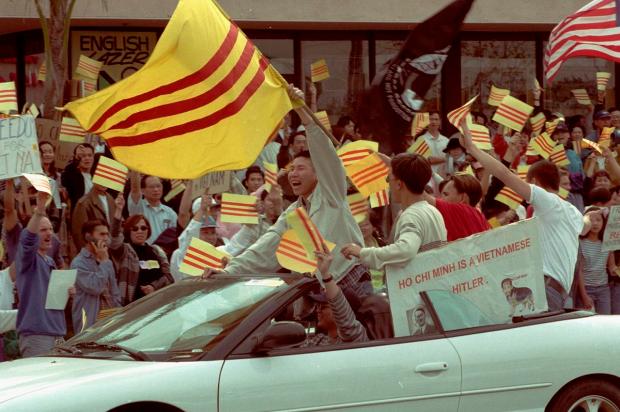
But he and I have our tense moments. We vehemently disagree on matters of race, gender, religion, and politics. He was socialized through the some of patriarchal elements of Vietnamese culture, the fundamental evangelical Christianity of Southern Baptists, and extreme views from factions of the Christian Identity Movement (bizzaare, I know – I promise to explain fully someday).  He votes Republican mostly because of abortion and anti-communism. He’s the man who thinks Ho Chi Minh is worse than Hitler. Last Christmas I walked away from a conversation at my sister’s house because the political conversation with my Dad got so heated.

On the road trip to Mississippi, he didn’t bring up Trump. I was actually feeling warmth and connectedness with him. I admired his USAF pilot certificates, his USAF wings pin, and his renegade casual style of dress at the business casual reunion event (he sported sneakers, dad jeans, white t-shirt, and a black zip up jacket he wears all the time because my mom once complimented him in it; everyone else was in suit, tie, shiny belt, and dressy shoes – see photos at the end for evidence). I was glad that the whole way there he never mentioned politics. It was on the way home that the conversation turned to Trump because my Mom brought him up. She’s not religious. She’s not even political. But she’s very engaged with what is going on in Vietnam. You see, her family is still there. Although her parents are both gone, her siblings and extended family are there. She has made over 20 trips to Vietnam since the country’s economic reforms started in 1986 called Doi Moi. Part of this reform recognized that the vast amount of money that Viet Kieu (overseas Vietnamese) were remitting to their families in Vietnam could be a monetary injection to the country’s economic woes. Mama’s body is here with us, but part of her heart has always been and still is in Vietnam.

Recently, the citizens of Vietnam have been protesting the Vietnamese government’s economic deals with China. Several of Vietnam’s most desirable areas for development have been leased to China for 99 years. This land grab is also happening in Laos, Cambodia, Thailand, and various other areas in Southeast Asia. The land is developed into high end, luxury resorts and have become enclaves and playgrounds for the Chinese – worst of all, they don’t employ or even allow non-Chinese on resort playgrounds. Vietnamese citizens who protest are arrested and imprisoned. The Vietnamese government has explicitly stated they would punish protestors. They even arrested and imprisoned a young Vietnamese American from Houston who was in MBA school in Singapore and went to Vietnam for anti-Chinese protests. He was released 40 days after his arrest and deported from Vietnam. Upon his return to America, he spoke out about how he was coerced to make an apology on Vietnam’s state television and promising to not participate in any more anti-state activities. There are news stories from Vietnamese American programming airing out the human rights violations that the Vietnamese government are committing all for the economic gains of corrupt government officials who are in bed with China. Needless to say, many Vietnamese, including my Mom, HATE the Chinese. So she likes the fact that Trump waged a trade war against China. The hope is that China will sink and take the Vietnamese Communist government with it. My Dad stayed silent on the matter. I think he didn’t want to ruffle my feathers. Mr. Tong and Mr. & Mrs. Thanh strongly agreed with my Mom.

I learned that Mr. Thanh was one of the pilots who couldn’t make it out of Vietnam after the Fall of Saigon. Left behind, he was arrested and sent to “re-education” camp as a prisoner of war. For the first year, his wife didn’t even know if he was alive or not. Upon learning a year later that he was imprisoned at a camp hundreds of miles away, she wanted to see him. The government allowed his family to visit for two hours, once a month. Her journey to see him took an entire day of travel. Mrs. Thanh told me during the first visit, all they did was cry. Tears and wails from a mixed bag of emotions – joy that he was alive, anguish that he looked so frail from hunger and thirst, anger that he was regularly beaten, and hope that he might someday be released. For 6 years, she took the day long trek once a month to see her husband for two hours. He was eventually released, but they lived in dire poverty and under constant surveillance and fear. In 1989, the US adopted a program known as Humanitarian Operation which allowed those who were imprisoned for their loyalty to either the South Vietnamese or the American government to leave Vietnam. They applied and in 1996 that they were able to leave Vietnam for the American Dream. But it wouldn’t be easy for Mr. and Mrs. Thanh. As a former political prisoner, Mr. Thanh faced daunting financial and social obstacles. He and his cohort of former political prisoner countrymen were old men, with an average age of 58, and struggled with being so old and set in their ways to adapt to a new land, learn the language, and find good jobs. For many, they were unable to cope. We knew several who had committed suicide, often leaving behind suicide letters describing their disillusionment with the reality of their American Dream. Mr. and Mrs. Thanh faced many struggles, but they agreed with my Dad that they were lucky to come to Houston where a large, established Vietnamese community already existed. The resources and networks of people like them assisted them in adjusting to life in America. They are grateful for their working class life and for the opportunities their children took to succeed as the next generation. Mr. and Mrs. Thanh hate the Communists, hate the Vietnamese government, and would like to see the government toppled. My Mom interjected a quote from a Vietnamese government critic, “The Vietnamese Communist government is evil. Either we topple them or we die.” Mr. and Mrs. Thanh, and Mr. Tong agreed.

The political history of Vietnamese Americans reminds us that the vast majority of the first generation of these immigrants vote Republican. The influence of their Catholic membership affirms their anti-abortion stance. The influence of war and oppression affirms their anti-Communist stance. So how did this make me feel after summarizing these things about the 5 Trump supporters? It was tough. I’m still processing it now, one week later. After listening closely and intently to their stories and perspectives, I decided to engage in conversation with them. I know it won’t change their mind about voting Republican, but I just couldn’t sit back in silence without at least speaking my own mind. They had their time, and I listened, so I hoped they would listen to my point of view.

Through my talking points, I got them to agree that the Affordable Care Act was a good thing for them. They didn’t realize that the Republicans are currently trying to dismantle it. I got Mr. Tong and my Mom to agree that abortion is a moral issue shaped by religious views and that there is no place for religion in politics – the separation of church and state. My Dad and Mr. & Mrs. Thanh disagreed given their religious devotions. I got them to agree that Trump lies, but their rationale was that every politician lies. I got Mr. Tong and my mom to agree that Trump’s anti-immigration policies are cruel and that it is negatively affecting Vietnamese Americans. Mr. and Mrs. Thanh and my Dad felt that illegals are breaking the law, and that Vietnamese immigrants who broke the law deserve their punishment even up to deportation. I was baffled by my Dad’s views because my uncle (his youngest brother) was recently released from prison. He gained citizenship prior to being incarcerated. I posed the hypothetical to my Dad, “What if Uncle was not a citizen and was now going to be deported? How would you feel?” He stood by his view that even my uncle should be deported if that was the law. None of them care that Trump has been deemed a racist by many because perhaps they themselves hold views on racial hierarchies – it hurts to know that a sizable portion of Vietnamese Americans hold these views. They learned the racial hierarchy through the saturation of negative stereotypes and demonizing of minorities in the media. My Mom, however, sees the world more through class. She would be ok with me marrying a black man as long as he was rich. My dad would not be happy with me marrying a black man at all. Something about some scripture verse about race mixing being an abomination to God… when he first told me this decades ago, I remember being so angry and yelling at him in my head, “What the fuck ever are you talking about?! You’re fucking crazy!” Mr. Tong and Mr. & Mrs. Thanh agreed that they wouldn’t be happy if their children married someone black. I was exhausted at this point. I’m just exhausted typing this and rehashing this conversation. I just went silent after the race part of the conversation. I guess I was too hurt and emotionally drained to keep going. I stayed silent the rest of the ride home to Houston. At that point, all I could do was chuckle to myself at my predicament, realizing that I was on a road trip from Mississippi with 5 Trump supporters while at the very exact same moment in Oceanside, Ca, at MiraCosta College – the college where I teach – Bernie Sanders, Mike Levin, James Elia, Eric Dean, and a whole host of other progressive champions were gathered to rally young voters and endorse Democrat candidates. Why was I in this energy draining space of cognitive dissonance when I could have been in an energizing space of confirmation bias?

A couple of days ago, I read a piece by Tayari Jones in Time titled “There’s Nothing Virtuous in Finding Common Ground” where the author notes,

“The middle is a point equidistant from two poles. That’s it. There is nothing inherently virtuous about being neither here nor there. Buried in this is a false equivalency of ideas, what you might call ‘good people on both sides’ phenomenon. When we revisit our shameful past, ask yourself, Where was the middle? Rather than chattel slavery, perhaps we can agree on a nice program of indentured servitude?… The search for the middle is rooted in conflict avoidance and denial. For many Americans it is painful to understand that there are citizens of our community who are hold racist, sexist, homophobic and xenophobic views. Certainly, they reason, this current moment is somehow a complicated misunderstanding. Perhaps there is some way to look at this – a view from the middle – that would allow us to communicate and realize that our national identity is the tie that will bind us comfortably, and with a bow. The headlines that lament a ‘divided’ America suggest that the fact that we can’t all get a long is more significant than the issues which we are sparring… Is it more essential that we comprehend the motives of white nationalists, or is it more urgent that we prevent them from terrorizing communities of color and those who oppose racism? … For the people directly affected, the culture war is a real war, too.”

Agree. I totally agree as a reader. So how do I reconcile this given that my parents are Trump supporters? I ask you, dear reader, no matter where your political views lie, have you decided that in this current political climate, you would shun someone and not engage with them if they are on the opposite side of where you lie on the spectrum? I confess I have done this to many. But my parents. It’s non-negotiable. The political distance is something I endure because for me, in the broader scheme of family, love runs a lot deeper than the political climate.

Needless to say, I’m back in Oceanside and back in my comfort zone. I remain hopeful. My cousin’s daughter, a 19 year old, just voted for the first time in her life, and she voted for Beto. Another group of young Vietnamese I met and talked to in Houston also voted Beto. A Vietnamese American close to me and close to my age who is religious and conservative told me she hates Trump. She is voting for Beto. These examples feed my anecdotal evidence of a wave of change in the Vietnamese American political landscape. And my observations reflect a larger trend – a recent article from NBC News reported that  Vietnamese Americans in Orange County, CA (once largely Republican) are now moving toward progressive policies based on issues they care about – housing, immigration, gun reform, healthcare, and income inequality. Organizations like VietRISE, a progressive Vietnamese community organization in Orange County, are educating the community on the issues. There’s hope. And that gives me the energy to keep doing what I’m doing – to educate people on the issues. Does this mean I’m trying to find common ground with Trump supporters, like my parents? No. I don’t think I’ll ever have common ground with my parents. Does this make them bad people? I say no, but in the context of politics, I believe their views are harmful to communities I care about. Their views are bad for the poor, the disenfranchised, the marginalized, the oppressed. But I can’t shun them. It’s much more complicated than that. I just have to reconcile that loving my parents will have to be compartmentalized – my actions will always be true to my values and sometimes those values reflect the good things they taught me. So it means debating with them, too, and that requires conversation, connection, and understanding. But believe me, I debate with them a lot even outside of political issues. It’s a push and pull. Just like growing up Vietnamese in America. There are cultural artifacts of each that I had to negotiate with and then decide on my own which beliefs, practices, and values I would uphold and which ones I would reject.

Let me end by showing you some pictures and sharing their narrative. If I never told you my Dad was a Trump supporter, would you view these photos differently? Would the narrative that these photos tell be reshaped in your mind because you now know he’s a Trump supporter? Hope to hear from you and what you think.

Dad fought for his beliefs and felt the need to save his country from the oppressive regime of the Viet Cong. Being selected to train for pilot certification with the USAF was very prestigious in Vietnam. The Military Assistance Program’s Flight Training School originated in 1958 and was intended to be a 4 year program. As a result of the escalating conflict in Vietnam, in 1967 it was anchored at Keesler Air Force Base in Biloxi, Mississippi, and was at the peak of its operations in the years after. From 1967 to 1973, over 1,100 international student pilots were trained there. Of those, 743 were from Vietnam. During that time, over 200,000 hours were flown with Student Pilots representing 34 nations. Student elimination rate at the height of this training was only 4.7% compared to the American student base rate of 25%. It made me proud of my Dad for his accomplishment. He completed his pilot training in 1971 and returned to Vietnam with flight missions on the C-130 Hercules, a large cargo plane. In 1975, the Viet Cong won and my Dad, my mom, and me escaped – eventually processed as refugees seeking asylum and placing our first steps on American soil at Eglin Air Force Base in Valparaiso, Florida, on May 27, 1975. The local community opposed us and did not want us there. How ironic that a New York Times article reporting from Niceville, Florida, showed how not nice the residents were…[excerpts from the article, “The Vietnamese Are Corning and the Town of Niceville, Fla., Doesn’t Like It” read it in full here]

“Far’s I’m concerned, they can ship them all right hack.” snapped one woman here today—and from one end of town to the other and in the cities around the base, many of her neighbors agreed.

A petition asking that the refugees he placed elsewhere was being circulated here this morning. Children in one local school joked about shooting a few of the refugees. With various adults were making clear that the Vietnamese are not welcome.

In a radio poll taken by station WFTW yesterday, 80 per cent of the people who responded said that they did not want the refugees to be brought to Eglin.

In Grady H. Temberlin’s Barber Shop in Valparaiso, he and a customer were talking about the incoming immigrants. “We got enough of our own problems to take care of,” Mr. Tomberlin said. “You’re right.” his whitehaired customer said, shifting nervously beneath the striped cloth. “They don’t even have enough money to take care of Social Security now—and they want to bring in more people.”

Mr. Tomberlin snipped angrily away behind the man’s ears. “I don’t see why I ought to work and pay taxes for those folks who wouldn’t work over there. They ought to have stayed on over there,” he said.

“Right,” said the customer. “Who the hell’s going to feed them when they get here?”

“We are.” said Mr. Tomberlin. “We are.”

Does this report from May 1, 1975, sound eerily similar to reports we read and hear today about Syrian refugees, Iraqi refugees, and the current “migrant caravan”? My Dad’s flight instructor, Mr. John Heckleman, supported the Vietnamese refugees coming to America. So did thousands of others who even sponsored Vietnamese refugee families so they could resettle in cities and towns across America. My Dad and his buddies probably never read about the objection to our coming to America. Their only experience was receiving the support of their U.S. military connections and the charitable folks who welcomed us with their time, energy, and donations. When I started digging into my past for my memoir, I asked my Dad some details about being at Eglin. After we talked in great depth about it, he asked me to go on the internet and look for someone who he never forgot from Eglin – a young soldier who was stationed there temporarily to help the refugees. Before he left for his next deployment, he handed my Dad a wad of cash – $30; told him to use it to take care of his wife and kid. My Dad wants to find him and thank him. He wants him to know my Dad never forgot his kind and generous gesture. I haven’t been able to locate him. He remains elusive because my Dad can’t recall the exact spelling of his Argentinian name.

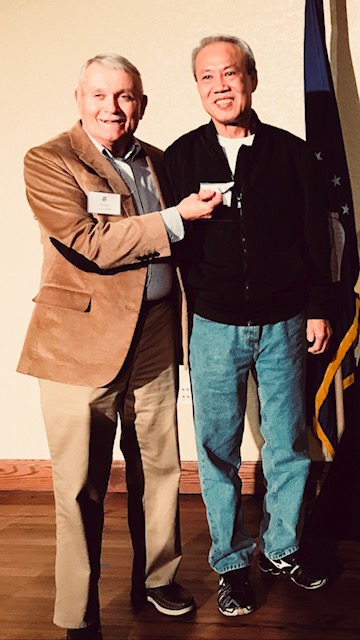
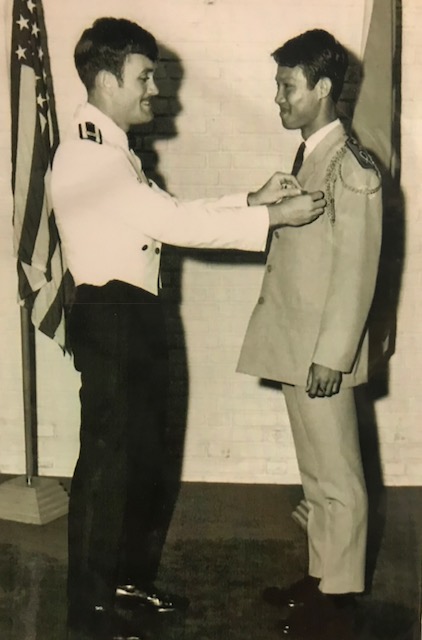
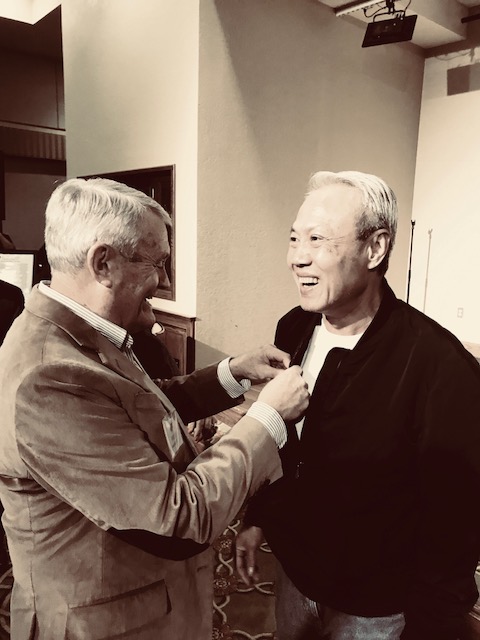
Before we left Mississippi, Mr. Heckleman presented my Dad with a gift. When he found out my parents’ house was destroyed by Hurricane Harvey, he was afraid all of my Dad’s photos from his training days were gone. He went through his old photos and reprinted all the ones with my Dad then placed them in an album. My Dad and Mom were so touched. During the ceremony, my Dad was given a reprint of his flight certificate he received at his graduation in 1971, and they pinned him new wings. Not only was my Dad reunited with his flight instructor after 47 years, he was given the gift of commemoration – remembering the honor and the valor of his patriotism to his country and to the United States.

In closing, I’m a harsh critic of the American government when it comes to the Vietnam War. Ken Burn’s “Vietnam” really opened my eyes to a lot. My parents won’t watch it because it features interviews with individuals who fought for the Viet Cong. It is often this duality in experience – leading to a difference in education, a difference in world view, a difference of the generation gap – that causes my rift with my parents. It’s one I’ve struggled with all my life. And as you can see, it is a continuous struggle. I will never turn my back on my parents. They gave me life, they worked tirelessly to give me the opportunities I took to better myself, they taught me to help others, they supported me through some of the worst times in my life – but they also gave me the courage to be independent, to have my own thoughts, to fight for what I believe in, and to do what I think is right for me. Those lessons are a double-edged sword for them because the voice and the backbone that I use to push back against them is one they nurtured and developed. As much of a struggle as it is for me, it must be a struggle for them as well. But they’re proud of me, they love me, and they help me when I’m in need. I’m proud of them, I love them, and I will always help them if they’re in need. And there’s no way in hell that I would let that motherfucker Trump come in between me and my parents.

IMG_1193

The barracks where my Dad stayed in 1971
IMG_1191

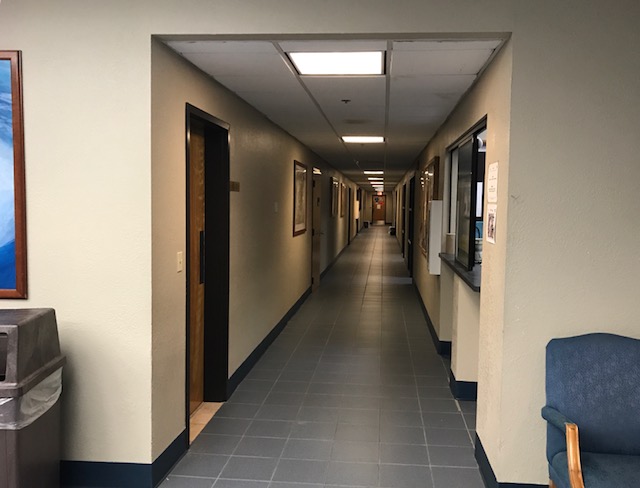
The halls where he studied

IMG_1365

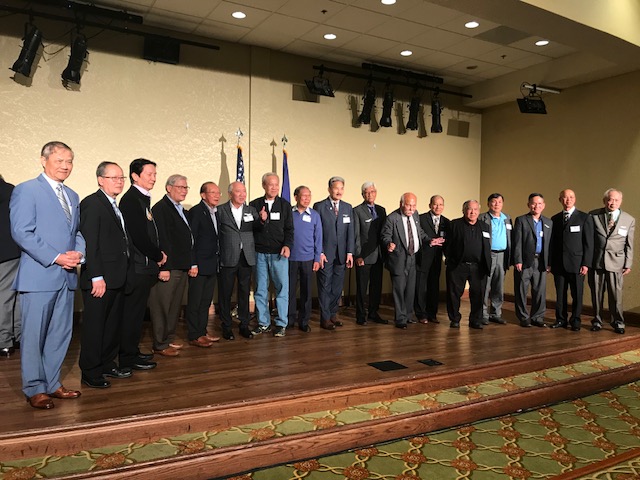
His class and the plane they trained with, the T-28
IMG_1224

His class reunion 2018 and notice his renegade attire

IMG_1186

The plane he flew for his missions in Vietnam the C-130  Hercules

IMG_1253

With his instructor in 1971

IMG_1250

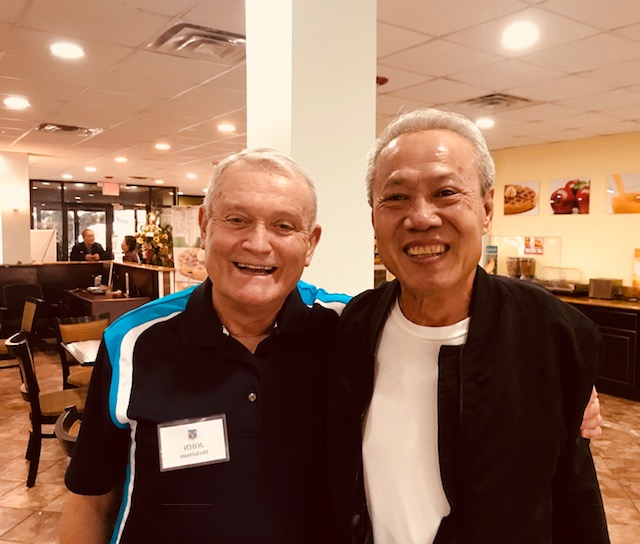
Graduation day with his instructor 1971
EAAE8E1C-7C19-4F6F-8298-F7C762C6880F

47 years later at the reunion

IMG_1252

1971

87C6C5B1-D9B1-4ED5-9720-21B060AB6E61

2018

IMG_1251

1971

80B03A68-EB72-49C1-A4E2-B6D1D303462C

2018

IMG_1201

Why I Didn’t Report

I’ve been stuck. Writing this memoir has been a huge challenge. I hesitate when I start to write about deeply personal experiences. I debate about whether I want others to know what happened. Why do I sit in the shadow of shame when it comes to some of the things that I’ve experienced? I ask my students in the very first week of the semester to share their personal selves with me, and they share a lot! I realize now, more than even before, how courageous they are — to trust me… a total stranger, having authority over them, with their deeply personal selves. How come I haven’t been able to be brave like them? For weeks, I’ve been sitting still with my thoughts, my feelings, and my fears. My fingers are paralyzed, unable to manifest keyboard strokes that could narrate a collection of memories which define me, and yet haunt me at the same time. That is, until today. Something happened today that I can share with you through storytelling, but I could never fully explain the dynamics of how it unfolded in such an ethereal, and at the same time, eerie way.

I’ve followed the political tensions of the Kavanaugh nomination with keen interest for many reasons. As a woman, the framework of patriarchy, women’s rights, and the #MeToo movement are personal. As an academic, a sociologist, the same framework illustrates the ways that power gets wielded in forms of individual, institutional, and structural sexism/misogyny. Watching the live testimony of Dr. Christine Blasey Ford this morning was supposed to be like any other privileged opportunity I’ve had during the sabbatical – time and freedom to be in the comforts of my couch, watching the full broadcast of a political account unravel. It is a distinct historical moment in America’s political machinery. As I listened and watched her, I got very emotional. I sympathized at first. Then I empathized. And that’s when it triggered me.

I was in my early 30s. Not a young girl, not an adolescent. A full, grown woman. I was a graduate student at the University of Texas at Austin, but I was in Houston a lot. Visiting family, seeing friends, spending my weekends being around the people in my hometown. I knew him from my years as an undergraduate at the University of Houston. He played basketball with guys I knew in school. We saw each other in the gym sometimes when I was there playing volleyball. Our sports circles crossed when we attended tournaments around town. We had common friends. We eventually became friends. He had a girlfriend, but I only met her once. She was very studious, so she didn’t come out to the sporting events much. When he told me he was going to ask her to marry him and that he needed my female perspective to help him pick out a ring, I thought it was adorable of him. I was enthusiastic for my friend when he invited me to go with him to the neighborhood mall to go ring shopping. I asked him questions about his girlfriend’s style, but he wasn’t able to describe it effectively. There was no mainstream social media then so I couldn’t go look at pictures on her Instagram to determine her “style”. I asked if he carried pictures of her in his wallet. He didn’t, but he said his apartment (which he shared with his soon to be fiancé) was near the mall. He suggested we go there because he has an album of pictures I could look through to determine her style. I thought nothing of it. And so we went. It was a one bedroom, kitchen on the left of the entry door, open concept living room. Bedroom to the right of the entry door, opposite the living room. He led me to the bedroom where he wanted to show me a large picture frame with several pictures of him and her. It was one of those giant pieces that had multiple frames connected to each other and stood the size of a room divider. I remember there was no bed frame, only a mattress on the floor. Her nursing school homework was strewn across the floor and school books were piled around the room. Then I looked at her pictures carefully, wanting to help him find the right ring for their special moment. But I felt an uneasiness being in their bedroom alone with him. So I asked about the photo album he mentioned when we were at the mall. I followed him to the living room. I sat down on the couch and waited for him to produce the album. Instead, he handed me a few pictures of her and some of him and her. As I studied them, he put his left arm around my shoulders and thanked me for helping him. I didn’t like it. I glanced at his left hand draped over my left shoulder blade, then I turned to him to give a disapproving look. I thought he got the message because he verbally apologized, but then he didn’t move his arms nor his hand. I turned my body away from him, and that’s when the drape of his hand turned into a full grip of my shoulder. In that moment, I was petrified.

Him: “Listen Thao. I’ve always liked you. You’re like, my dream girl. I’m wondering if there’s a chance with you. If there is, I want to give it a try.”

I couldn’t process what was happening.  He has a girlfriend. We just went shopping for her engagement ring. We’re in his apartment looking at pictures of him and her. What the hell is going on?! I am speechless for a moment. He took that silence, that moment of my confusion, as an invitation to his request. He wrapped me in both arms, leveled his body into mine, and pressed his lips toward me. I turned my face to avoid a kiss, but my body couldn’t move. His lock was so strong, his body so heavy, weighing me down, pinning me, immobilizing me. Fear raced through me. I was afraid I had lost control of the situation, afraid of being forced to do something against my will. He was in charge, overpowering me, physically and mentally.  His hands went forcefully down my top, grasping at my breasts. I don’t know why my initial reaction was to reason with him.

Me in calm voice: “Please stop. I’m not interested in you. You have a girlfriend. Please don’t do this.”

It worked for a moment. He stopped groping me. He took some of his weight off me.

Him: “You don’t want to give us a chance? I’ll leave her for you.”

I don’t know what happened to make me snap out of my fear. I suddenly felt rage. I felt rage for him betraying his girlfriend. That’s right. Not rage at what he was doing to me, but rage at what he was doing to her. I don’t know why I wasn’t angry, at that moment, about what he was doing to me.

If you know me well today, you know I have a fighting spirit. If you knew me when I was younger, you know I have been in many physical fights. But I never picked fights. I never looked for fights. I always defended – my sisters, my friends, my family, myself. It was time to break from my paralysis and go full fight mode.

I conjured the woman warrior in me, flexed all the muscle fibers of my frame, and used my legs and center of gravity to burst myself free from him. I sprung from the couch and faced him. I leaned toward him, not away. Lean in. I thrust my finger in his face.

My fight voice roars: “Are you sick?! Do you hear yourself?! I am not interested, and you have a girlfriend! We just went together to buy her an engagement ring! Stay away from me. Don’t ever talk to me again. If you ever come near me again, I will tell her everything.”

He was stunned. I grabbed my keys and ran for his door. He followed me, only to beg me not to say anything to her. I ran out and down the stairs, then sprinted to my car. I looked back to make sure he didn’t follow me. I was free.

I didn’t tell anyone right away. I was afraid they would think I was stupid to be alone with him, especially in his apartment. I was afraid they would think I deserved it.

Some days later, I told my sisters. They, like me, were so upset that he did this to his girlfriend. I am still trying to process and understand why we didn’t know then that this was sexual assault. Or maybe we did, but we didn’t know what to do about it. And we weren’t upset or worried about me. We were angry about his betrayal to his girlfriend – because we understood then, very clearly, that cheating on your girlfriend was a big deal. A bigger deal than sexually assaulting me. We thought that only rape was bad. We thought that because I had stood up to him and escaped him, that I won. But did I? I don’t know. I guess I’m not trying to make this a winner/loser thing. I’m trying to share and trying to understand why… – thirty something years old, college educated, athletic, strong willed, fierce, fiery, independent – all these things were me – why not once had it crossed my mind to do anything else about the incident or to call the police. I didn’t even know it was an option. When I think about it now, it makes me feel like I was so dumb. So naïve.

Weeks later, I saw him at a flag football tournament. I looked at him with disgust. I was so overwhelmed with disgust that I told a male friend, Luan, who was there at the tournament with me. He knew my assailant. They were friends. I had confided in Luan years earlier about something terrible that my then boyfriend had done to me. Luan always listened, with no judgement, and never gave advice unless I asked for it. He understood and was prepared to defend me if I ever needed him to. He believed me. It is no wonder that today, he is a successful defense attorney.

Over the years, I don’t know what happened to my assailant. He did marry his girlfriend. I heard they live somewhere in California. I never told her. I was afraid she wouldn’t believe me anyway. I decided to let karma run its course and left it up to the universe to flex its consequences on to the perpetrator.

I never thought deeply about the incident much after that. It wasn’t until today, when I got so emotional watching Dr. Ford speak about her trauma, that it triggered me to feel something about what happened to me. I, personally, believe her. But I’m not writing this to confirm that she must have been telling the truth. I do understand that the cognitive processes and experiences of other people could shape them to perceive her as a liar. Confirmation bias is very powerful, both consciously and subconsciously. I write this because I have been afraid to revisit the experience and to share with a public audience what I went through. It’s the same fear that has kept me stuck in neutral with my memoir writing – the engine is on, but I’m not moving anywhere even as I step my foot on the gas. I’m afraid to shift into drive gear. My fear of what people will think has stalled me.

I saw all the #MeToo stories come out. I read all the heart wrenching #WhyIDidntReport confessions of women and men across the world. They were so brave. But I still didn’t want to share my experience. I was still dismissing my own trauma. I was repressing my rage, my anxiety, my worries – leaving me in my paralysis. When I watched Dr. Ford, my paralysis was undone through an emotional ignition. I cannot believe how courageous Dr. Ford was for sitting in that seat. I know the truth of my experience, and I did tell more than one person. But I cannot say for certainty that I would be able to be in Dr. Ford’s position in the full context of the situation and share what I just shared.

I never sought treatment nor therapy nor law enforcement. I confided in my sisters and one friend. The last time I saw my friend was four summers ago. He, his wife, and daughter visited. After that, I hadn’t spoken with him since. Not because of any falling out. We have just been busy with our lives. And we are the type of friends that go so far back that we can pick up right where we left off no matter how many years had passed. I thought of him this morning as I was rehashing what happened to me.

There was a moment this morning when I doubted myself. I was afraid I might be wrong. I vividly remember certain things, but if I was being interrogated under oath about certain details that the law would require me to remember to make a case, I don’t know if I could recall them. What was the exact date? I don’t remember. What time of the year was it? I don’t remember. What was he wearing? I don’t remember. What were you wearing? I only remember it was a red tank top with a V shape neckline. I remember because I was mad at myself for wearing something that revealed my cleavage and made it easy for him to access my breasts. Yes, I blamed myself for what I was wearing. So now at least I could say it wasn’t winter. But it’s Houston. So it could have been spring, summer, or fall. Do you think I’m not telling the truth because I can’t recall those details? It saddens me that some people really believe that victims of assault should be able to remember everything in detail or else they are not telling the truth.

So I text my sisters asking them if they remember me telling them about what happened. They instantly replied yes. What a relief. They remember it as I remember it.

I thought about asking my friend, but I was afraid it would be too weird – an out of the blue call when we hadn’t been in touch in over 4 years to ask if he remembers me telling him about the assault. So I didn’t. My sisters’ validations were enough.

At 12:30 pm, PST, my friend’s name is flashing on my phone. He is calling me. I feel a chill come over me as I answer.

Me: Oh my goodness, hi!

Him: Thao! It’s me, Luan!

Me: What the hell, man?! How are you?! To what do I owe this pleasure of hearing from you? (I am purposely trying to not make it awkward even though my mind is racing and nerves are firing rapidly).

Him: Do you want the truth or you want me to lie to you? Hahaha

Me: Oh come on man, you better tell me the truth!

Him: I was clearing out contacts on my phone, so I wanted to call you to make sure you were still at this number. So you’re still at this number. That’s great!

Me: Ahhh ok! Well yes, I still have this number. But I HAVE TO TELL YOU SOMETHING, PLEASE. Do you have time for a chat?

Him: Yeah, what’s up?

I proceed to tell him about everything I experienced this morning and that I thought of him but didn’t call for the reasons I stated earlier. He was stunned. He confessed that he was listening to the hearings earlier in the day, and for a moment, he thought of me and what I told him and how he felt bad for what I had been through. He didn’t think to call me, but when he cleaned out his contacts on his phone and came across my entry, he was going to call to make sure it was still my number.  He said he was not going to mention that he thought of me when he was listening to the Senate hearing. He didn’t want to make it awkward for me.

So here we are, thinking of each other while Dr. Ford is telling her story. But neither of us had planned to mention to the other, “Hey, I thought about you because of this hearing and because sexual assault is at the center of it all.” We had planned to stay silent. But the connection of our thoughts brought us together in this moment. He asked if I was ok. He didn’t want the experience now to conjure up the past and damage me or bring me down. I told him I’m ok. I thanked him for being my friend, for listening to me, and for believing me 15 years ago. I told him I wanted to write about what happened then and what happened today, but I wasn’t sure. He encouraged me to write about it all. He wanted me to use his name and not keep him anonymous. I am so grateful for his friendship.

And now, I am not as afraid anymore. I still feel reserved about sharing this. But I am telling this with less anxiety about what someone may think of me, or if someone will judge me. I didn’t tell then because I am not the same person that I am now. I was not in the same situation as I am in now. Our society was different then than it is now… or is it? I was 17 years old when Anita Hill had her experience televised. I read that it was very similar to Ford’s. Some of the politicians that were part of Hill’s testimony are part of Ford’s – 27 years apart! I realize that if Kavanaugh is confirmed, then not much has changed. As a survivor, of numerous instances of sexual harassment and sexual assault, it is extremely painful to reflect on what these other women have endured. I can never thank them enough for their courage. Their experiences helped me confront, process, and come to terms with my own experiences of sexual violence. I still have a ways to go in dealing with other traumatic experiences, but I am now armed with more courage than I had before the events that transpired today. These courageous women are directly helping me to shift into Drive gear, put my foot down, and gas this writing project forward.

#SheToo

Mama is on a plane ride right now, returning from her visit to our Motherland – Vietnam. While she was there, she caught up with me on FaceTime on several occasions. My siblings and I bragged to each other when one of us was able to connect with her.

Me: I got to FaceTime with Mom!

Sister 1: Nice, she called me first.

Brother: No, she called me first!

Me: Well then she called me last because she wanted to save the best for last!

Sister 2: She called me after you, Thao, so she saved me for last!

I’d like to think I am her favorite, but the siblings and I know she surely loved us equally, just in different ways. So no, I don’t think she has a favorite. She’s very practical about her love and how she shows her love. She is the kind of woman that simply gets shit done for us. Need a live-in nanny to your babies? No problem! Need some cash for your next financial venture? Absolutely! Need a meal after work? Done! Need your house cleaned? Sure! If she didn’t pay much attention to one of us, it was because she knew another sibling needed her more. She always took care of our needs and wants in order of urgency.

I’m the only sibling who lives out of state from Mama. When we have time for phone calls, she catches me up on family affairs and the lives of her friends. When I see her in person, we have these deep talks that stretch from heart to heart. They’re the kind of talks that I keep with me in my spirit and linger in my thoughts when I’m alone and missing my Mommy.

Many times, during our heart talks, she beams a grateful smile and reminds me of the time I “saved her life”. It was 1976 and we were newly minted refugees who had just settled in San Antonio, Texas. It was our first landing spot after fleeing Vietnam in 1975 at the end of the war. It was in San Antonio where #SheToo was gripped by the cruel hands of sexual assault. My father was at work. Mama and I were home alone with my newly born twin baby sisters. It was daytime when the knock at the door came.

Him: Hello, I’m a nurse from the hospital. My chart says you just gave birth to twin girls. Congratulations! I’m here to check on you to see if you are okay. May I come in?

She shook her head and didn’t know how to respond. Her English was barely there. As a daughter of rural folks in the rice fields of South Vietnam, she had not gone to formal schooling and never studied English. He seemed kind in his disposition with his friendly smile. He was an American. The Americans are our friends. They helped us in many ways.

He lifted a black oblong bag with black handles on the top. He opened the clasp at the top of the bag and reached in to pull out a stethoscope. He dangled it in front of her and smiled as he tried to show her he was there to help. She understood what the device was. The thin black tube with a round silver medallion at one end and two pieces at the other end that plugged into their ears – she recalled how the people at the hospital used it to check her. Ahhh. He’s a doctor. She let him in.

He sat down next to her on the only couch in the living room. The twins were sleeping, and I was there with her, a 3 year old refugee kid who was only scared of one thing Mama told me – police sirens. He started innocently and professionally with the stethoscope on her chest over her shirt. He moved it from the right side to the left. He moved it to her back, first center, then right, left, then up, and down. He then turned her shoulders so she would face him. He then slid the scope between the buttons of her top. She did not move. He reached over with his other had and undid the top button. She became nervous as he slid the scope further away from the upper part of her chest down toward her breast. His fingers let go of the scope as he opened his palm, cupping her breast. He lunged toward her and began kissing her and fondling her breast very aggressively. Mama was so scared, but she wasn’t strong enough to push him off. She screamed out in Vietnamese, “Thao, go get your Auntie!”

Auntie was not really an auntie. She was a friend who lived in the unit above us. She was a beautiful young Vietnamese woman who lost one of her limbs from the knee down due to a land mine that blew up her bus in Vietnam. She was the only survivor. Despite her missing limb, the exotic beauty managed to marry an American pharmacist, Mr. Don. They lived above us. I knew that no one was home. Both Auntie and Mr. Don both worked during the day. But the other thing I knew at that moment was that Mama was very scared. The American man was scaring her. I was scared, too. So when she screamed at me to get my Auntie, I got up and ran. He saw me from the corner of his eye. I had to go past the couch to get to the front door. As I dashed by, he lunged at me trying to grab me. His hand came within inches. Fear and instinct must’ve taken over my little runt of a body. My left shoulder leaned forward and to the right, my tiny steps full speed as my body tucked and I ducked away from his reach. I ran like a hare up the 2 flights of stairs to the next floor. Mr. Don and Auntie were not home, but I had to pretend like they were so I banged on the door with my tiny fists.

Mama said he grabbed his things and left quickly. Mama was so frightened. She wanted to lock the door, but her baby girl had run out. Did she really run upstairs? Didn’t she know that no one was home? What if she ran outside? What if the man has her outside? Mama called for me, and I replied. Mama ran upstairs. There I was, still banging on the door. She scooped me up and frantically went back downstairs. She was afraid he might be there, but what could she do? She could only hope he was scared away by the thought that the neighbors were coming. And her two other babies were sleeping inside the bedroom. She had to get back to them. Such a relief to reach the front door and see no one. Inside, she ran to her twins who were still sleeping. With me by her side, she locked the door, hugged me tight, and we both cried until my father got home.

Mama never lets me forget that I “saved her life”. I get very emotional at this idea because on countless occasions, Mama saved my life. Heck, she GAVE me life! When we have a heart talk about this moment in our lives, never once did she mention how it traumatized her or how it made her think poorly of Americans or how she was too scared to go anywhere or how she felt violated. She just files it away as something we had to overcome so we could continue building our lives.

When I reflect on the incident these days, I sometimes wish there was a way to find that asshole who did this to Mama. I want justice. I wonder how many other victims there might have been. But Mama doesn’t want me to hold on to the past.

Mama: It’s ok, Thao. Nothing really, really bad happened because you were smart, and brave, and fast! You saved my life.

Me: Oh Mama, I would do anything for you.

Mama: I just need you to do your best and be happy. Be a good person. That’s all I need you to do for me.

Everyday, I have to do my best, be a good person, and be happy. It’s what Mama is expecting of me. I can’t wait for her to land in Houston tonight and call me. I miss her bubbly voice and lovely face with that milky, creamy porcelain complexion. Happy Mother’s Day, Mama. Because of you, I always try my best, try to be a good person, and am very happy that you are my Mama.

Mama

Vietnam and the Voices of Opposition

Do you remember April 30, 1975? Do you recall the time before and after that day in history? As a Vietnamese American who was 18 months old on that day, I am only able to understand the experience through the lens of my parents – my father, the Vietnamese C-130 Hercules pilot for the South Vietnamese Air Force; my mother, the seamstress who tucked my ill infant body under her wings and ran like a running back during their escape. My own memories are in the years after – some of the earliest are from when we settled in San Antonio, Texas in an attic of a sponsor’s home. I peered out the attic window in silence as my mother tended to my twin baby sisters who were born in San Antonio in 1976. I watched the people passing by, not yet understanding the difference between us and them – White Americans who experienced the Vietnam war in their own way. I can’t put my finger on a sense of how much time I stood looking out the window waiting for my father to come home on the bed of a truck with other workers who toiled with him on a watermelon farm. With no toys, no television, no anything, all I did was stand.

Mom asks, “Thao, what are you doing?”

I reply in toddler words, “I’m doing standing.”

When the police sirens would blare, I would dash under the bed. As a 3 year-old, my sense of fear and the trauma of war was already very real.

I reflect back on my parents’ lives during the immediate aftermath of April 30, 1975. Thrust into a world turned upside down, they did what they had to do. Survive. As with many others in the same chaos, somehow, slowly but steadily, they survived. And then they thrived. I’m grateful, yet melancholy at the same time. Oh the struggles they must have endured… the fears, the worries, the fatigue, the fight… day in and day out. Do what you gotta do.

They gave me a rich life.

Knoxville, Tennessee, in 1977 – my first major self-inflicted boo boo and my experience living in low income housing with poor African Americans. My boo boo was on a Big Wheel with a black girl in the housing complex.

Cedar Rapids, Iowa, in 1978 – my youngest sibling, a brother, is born and baptized into the Catholic Church. My sisters and I were given saint names. Mine is Theresa. I rode the bus to pre-school in the snow and cried when mom made me stay home when I was sick. At 4 years old, I already loved school.

Houston, Texas, by 1979 – our home, our hood, our place, even until today. Growing up in the South has been a complex experience with so much in terms of growing pains. Yet I realize that the American phrase “no pain, no gain” has truth to it. Everything that happened to me here has taken me to places I had only dreamed of, and yet here I am – thriving in Cali-forn-i-a! I was California Dreamin’ on many Houston winter days.

As a professor of Sociology, living in Southern California for 11 years, I’ve come to current realizations of my past. The Vietnamese American community absolutely has a vile vibe for the Viet Cong and its leader – Ho Chi Minh. Through my years of studying and exploring the social, historical, political, and economic facets of society, I’m constantly fascinated with documentaries and thinkers that examine issues through a lens of social justice. I’m particularly interested in how “truth” is told. Too often, we learn in an echo chamber, being exposed to things that reaffirm what we think we already know. So here I am now, confronted with new information on a framework I’ve been given pretty much all my life. Ho Chi Minh is evil. Communism is corrupt. Vietnam, today, is corrupt because it’s run by the Communists.

So I ask you and I ask myself –

Why is Ho Chi Minh evil? What were his motivations? What were his ideals and values? Are we sure some of him is not in some of us?

Is Capitalism also not corrupt?

Do we not live in an America today (and in its past) that is corrupt?

As I delve into the socio-political history of Vietnam, the Vietnam War, and Ho Chi Minh himself, I have to reflect on these locations, these events, and these individuals through a lens that is outside of the mainstream. Sure, the mainstream is a great source. But it creates an echo chamber of confirmation bias.

And so today, I am confronted with how to understand all these things with a broader, more inclusive lens. I realize that Ho Chi Minh was, in his own right, a revolutionary. In my support of civil rights and human rights, in America and all around the world, I have to reconcile that Ho Chi Minh might not be very different than those revolutionaries in the United States who fought and continue today to fight for rights, freedom, and civil liberties. Ho Chi Minh was in line with many of the revolutionary figures in the African American Civil Rights Movement, and they, with him.

I will be sharing a lecture tomorrow, May 1st, on campus about my personal journey and academic exercise regarding this reconciliation of “truth” from a new lens. Here’s a sneak peek into what my lecture will hinge upon…

“Dating back to at least 1924, the man who became known as Ho Chi Minh (Nguyen Ai Quoc) lived in upper Manhattan as an activist among the African-American community during the period known as the Harlem Renaissance. Ho worked with the organization led by Marcus Garvey known as the Universal Negro Improvement Association and African Communities League, headquartered in New York City at its zenith in the early 1920s. Ho reflected on his observations conducted just six decades after the conclusion of the U.S. Civil War and the legal dissolution of chattel slavery, in a period of extreme state repression, widespread institutional racism and arbitrary violence, in a 1924 pamphlet entitled ‘On Lynching and the Ku Klux Klan.’ The work documents various aspects of social conditions prevailing in African-American communities throughout the U.S.

He states, ‘The Black race is most oppressed.’

Ho Chi Minh left the U.S. and traveled to other parts of the world including Europe. In 1930, the Indochinese Communist Party was formed, encompassing revolutionaries from Vietnam, Laos and Cambodia who were battling French colonialism. Later Vietnam was occupied by both France and Japan.

Eventually, the United States entered Vietnam’s experience.

African-American opposition to the Vietnam War and solidarity with [Ho Chi Minh] were embodied by Malcolm X (El Hajj Malik El-Shabazz) and the Nation of Islam (NOI). They had been against U.S. involvement in Vietnam since the early 1960s. After leaving the NOI, Malcolm X adopted a decisively revolutionary position related to world revolution and spoke frequently of solidarity with the Vietnamese Revolution.” (https://www.workers.org/2018/02/05/black-liberation-and-the-vietnamese-struggle/)

—— So I ask myself, is Ho Chi Minh so vile? I understand why Vietnamese Americans (those who escaped Vietnam to run from Ho Chi Minh’s takeover of the Motherland, which includes my parents and myself) see him as such. Yet I also must confront the uncomfortable and unpopular view that he was fighting for an ideology and value system that rejected the imperial dominance of Vietnam by France, Japan, America, etc. His values advocated for the rights of oppressed African Americans. I share these values. For me, a Vietnamese American refugee, to state that I share values with Ho Chi Minh, is problematic. What will my father think? What will his military buddies think? What will my community think? ——

Did you know that in 1999, a Vietnamese American man named Truong Van Tran was beat up and harassed by Vietnamese Americans in Orange County, CA, for hanging a picture of Ho Chi Minh in his video rental store?

hi tek 2

hi tek 1

“[In March 1999] a crowd estimated at 15,000 gathered around Tran’s store, Hi Tek, an electronics-cum-video-rental outlet in a cramped mini-mall in Little Saigon–the unofficial name of Westminster, which lies about an hour south of Los Angeles. The demonstrators unfurled signs declaring, ‘our wounds will never heal! be aware! communists are invading America!’ They are not angry about some controversial video (the rental shelves carry nothing questionable; the most popular tape, Tran says, is a martial-arts epic in which a student of Buddha’s sends a monkey angel from heaven to fight evil on earth). Rather, the demonstrators started milling around Tran’s store in January after he defiantly displayed a flag of the communist government of Vietnam and a poster of the regime’s founder, Viet Cong leader Ho Chi Minh. That explains the effigies of Ho displayed above the shop; the gigantic flag of defunct South Vietnam hiding the storefront (and the offending poster); and the sign that reads, Ho Chi Minh is a second Hitler.

Two weeks prior, police in riot gear arrested nearly a dozen protesters after 300 people stormed barricades to attack Hi Tek during Tet, the Vietnamese New Year. Some activists vowed to set themselves on fire, emulating the suicidal monks of the 1960s. Last week’s larger but more peaceful crowd chanted slogans criticizing Tran as the sounds of mortar blasts and machine-gun fire boomed from loudspeakers. An elaborate shrine of candles, flowers and incense rests in front of two mock coffins bearing American and Vietnamese war victims. All that’s missing is food vendors. Nope. Here comes someone hawking doughnuts and soymilk.

‘We respect his freedom of speech, but he abuses that freedom’, says a protest leader and immigration consultant Ky Ngo.

‘Exercising your First Amendment rights is one thing; causing dissension in your community is another’, says Vietnam vet Larkin Kennedy, whose forearm is tattooed with the image of a Vietnamese lady he left behind.

‘I used to rent videos here, and I regret it deeply’, says Linda Nguyen, a student at the University of California at Long Beach. She sniffs: His videos were copies and so blurry.

At home, Tran insists he displayed the flag because it’s his country’s current symbol. Ho, he says, was a hero who helped liberate his people. And America is a liberated country, with real freedoms. I wanted to show the Vietnamese community that freedom means accepting an opposite opinion. – http://content.time.com/time/world/article/0,8599,2054075,00.html

It’s 19 years since that incident happened. Am I safe to speak my truth? Will I be treated with vilification as an ungrateful refugee who supports the Vietnamese Hitler???

I don’t know. But what I do know is that being an American has taught me to speak MY truth. The advocacy for human rights is never a safe space. It requires us to be uncomfortable. It requires us to be thought provoking. It requires us to take steps back and reflect with humility when we are presented with new information – even new entire paradigms for how we might see and experience the world in which we live. My academic voice tells me that academic freedom will allow me to explore controversial knowledge. But academic freedom and the 1st amendment won’t protect me from public opinion. Today, our current environment of public dialogue rests upon a divisive context. But today, more than ever, I am confident in myself as a professional and a human being who voices my perspective with conviction and intention; while at the same time, I am willing to dialogue with opposing voices. No matter how fierce, no matter how nasty, no matter how mean those voices might be…I must be willing to listen. My hope is to lead by example, and my optimism rests in the hope that those oppositional voices would give me a chance and listen to me, too.

Death, the Ultimate Teacher

I am not dying… yet. But it is inevitable. I was reminded of that today. Mortality is not an unknown. But it is the how, when, and where that elude us. I’ve seen death too often to never forget that life is short. And had I not been living by that mantra, I could have missed a chance to say a good bye to someone special in my life. A family member, not through Blood but through Love. My ex-husband let me know over the weekend that she did not have much longer. I knew I had to go see her, but visiting hours were limited and the hospice is an hour away. I planned to go Thursday when I had a morning break before a department chair retreat. But I’ve learned that when someone is in hospice, you just don’t know how long they have left. I was supposed to go to LA for a conference today, but last night I decided, no – I’m not going to choose work over saying good bye. What if she doesn’t make it until Thursday?! I knew the aggressive cancer had spread with no hope left to save her. Who is she, you ask? A woman I called Auntie by marriage. She was never married. No children. Devoutly religious. Strong willed. Fiercely independent. Wildly intellectual. No man had been a match for her, and she never wanted to settle. She was a high school teacher – Lincoln High in San Diego – and she lit up with beaming pride when she recalled her days of teaching her beloved student, Terrell Davis – Denver Bronco running back and 2017 inductee into the Pro Football Hall of Fame. She had so many admirable qualities. And she had supported me in many ways, even after I split from her nephew.

I left for Bonita this morning with a book in hand in case she might want me to read to her. She loved books. She was one of my biggest fans when it came to my writing. When I posted my writings, she would consistently ask, “When is your book coming out? You better do it because I want to read it!” She inspired me. Motivated me. Believed in me. That’s what teachers do. The book I brought with me was Happy: Secrets to Happiness From Cultures Around the World. I don’t even remember how I came to own the book. I decided right before leaving my place that I should get a book to read to her, but I didn’t have time to buy one. So I went to my bookshelf, and it was the first one on the outside corner of the top shelf. I saw it and grabbed it quickly. I had not even read it yet.

The family was happy to see me. They had not seen me since our split which was almost 2 years ago. They walked me to room 4. The door was slightly ajar. Purell and Kleenex were what I saw first, remembering the rules for visiting – clean hands thoroughly, wear a mask if you’ve been recently sick, and don’t come at all if you’re actively sick. As I entered the room and set my eyes on her, a deep sting hit my gut. It’s a shock to the memory to see someone dying from cancer. Their hair has fallen out, their skin is dull, and their body is still, near lifeless. There is such a stark difference from the vibrancy of life she exuded during the good times I spent with her. It pained me tremendously to see her this way.

She looked like she was sleeping, but Uncle D said she can hear us. So I said hello. She turned to me, opened her eyes, and smiled. She reached her delicate hands out to touch mine. I rubbed them and noticed her nails were beautiful. Tubes were pierced into her arms, flushing morphine drops to soothe her pain. More tubes snaked into her nostrils, feeding her artificial nutrition to sustain whatever is left of her gastric system. She whispered my name, “Thao.” She pulled me toward her, softly, gently, warmly. The tears could no longer be restrained. But in that moment, I remembered again, life is short. Don’t waste this precious moment with her in sadness! I centered myself, smiled as widely as I could, and began talking to her. I told her I couldn’t wait to start writing my book because she was always one of my biggest fans. I then told her I got my sabbatical approved for fall of this year. I will finish my book, with a dedication to her! She smiled and even tried to giggle, but I could see it hurt her to try. So instead, she opened her eyes and blinked many, many times. I pulled out the Happy book, and asked if she would like for me to read to her. She said yes emphatically with a smile and several slow nods. I scanned the table of contents to find a title that might be suitable for this moment. And there it was.. “Recognise Your Teachers”… HOW PERFECT.

IMG_4466
I read slowly, loudly, and enthusiastically. She would make soft sounds and smile, letting me know she was pleased with what she was hearing. As I finished, other visitors began to line up outside the door. My time was up. I had to say good bye. But no, I said, “I’ll come see you again and read to you some more.” She nodded, reached her arms out again, pulled me in very close, kissed my cheek, and held my face to hers. I will not forget this moment, thinking it might be my last with her, and knowing she won’t be around for me to read my own authored book to her.

I left the hospice to visit another Auntie on my ex-husband’s side. She was diagnosed with cancer last year, and she responded to her therapy quite successfully, so she was alive and well. She’s not out of the woods yet, but she is living her life to the fullest. We chatted about her travels, about family updates, and her daughter (ex-hubby’s cousin) was there, too. She is about deliver her first child any day now. We three had a lovely time lunching and laughing. We reminisced over stories of our times shared in the past and agreed life is beautiful which made us each feel good about what is to come. I left their home feeling a deep sense of fulfillment from the nostalgia of the past and bright sense of hope for the future.

I arrived home an hour later. Pork Chop greeted me as usual with his wildly wagging pom-pom tail. When I bent down to nuzzle my face into his and scratch him behind his ears, he climbed onto my lap and curled his body into my chest. He then dropped his face into the crevice of my neck, pressing it there for quite some time. He had never done this before. It was as if he knew… I needed a hug. My goodness, dogs are amazing creatures.

As if this had been enough confrontations of death as of lately. Last week my dear friend in Houston lost her mother. Two days ago my dear friend here lost someone close to him. And after saying goodbye to Auntie today, I learned of another death in the early evening – someone in my circle, that happened this morning – he was also a teacher, and he also died from cancer. What. The. Fuck.

He was a young and dynamic Vietnamese American man who loved his family, volunteered his talents for his community, and supported my jewelry business with many gifts for his amazing wife, also a teacher. He told me that he loved buying from me because his money was gifted two fold – one to his wife, the other to students. His last purchase was for their 18th anniversary. He sent a picture of his lovely wife wearing the pieces on their weekend getaway. They knew how to live life in the end – in the moment. He shared with me in our last conversation, “Dealing with cancer sure changed my priorities and outlook on life, and in many ways I think I have become a much better human being, husband, and father.” He told me to keep up the good work with my business and to keep teaching because we both agreed it is a labor of love. He inspired me. Motivated me. Believed in me. That’s what teachers do.

Look at it again – the passage from the Happy book that I read to Auntie.
Secret to Happiness:ACKNOWLEDGE YOUR INFLUENCES
Tradition:Visiting Teachers
Date:The third day of Tet (lunar new year: January/February)
Celebrated in:Vietnam

I did not get to visit my friend. I did not get to say good bye to him. I am so truly sorry. But know that I acknowledge you and all you’ve done with your incredible life.

Finally, I learned this evening that Auntie is no longer receiving visitors. It must be getting very bad for her. I believe the end is near. I am happy I made the choice to cancel work today. As much as I am dedicated to my labor of love as a teacher, I must remember my priorities.

The roller coaster of emotions today had me struggling to stay centered. It is through writing about these ups and downs and all around of emotions that ground me – and through the smiles, tears, fulfillment, regret, nostalgia, optimism, grief, and happiness – in the end, while death is certain for all of us, another thing is sure for most of us. There is tomorrow. A super blue blood moon will come upon us – 152 years since the last. I’ll rise up, take my beloved Pork Chop outside, look up at the beauty in the sky, and think of those who have departed. They will stay with me. They are out there, up there, dancing in the moonlight. I’ll dance along, sing them a song, and celebrate their lives by doing what they did for me. Motivate someone. Inspire someone. Believe in someone. That’s what teachers do.

Nature’s Gifts

It’s raining in Oceanside, CA. Oh sweet rain, how mesmerizing art thou! Living in Oceanside is a sunshine paradise. I love it, no doubt. But I miss the rain and treasure the occasional storms that make their way through here. The rat-a -tat-tats on the windows soothe my soul and bring me to a place of serenity and reflection. I dream of a glass house in the middle of a thunderstorm – lounging on a plush rug, a velour throw draped over freshly bathed skin, in front of a flickering log fireplace, the crackling of fire surrounded by sky water drizzling down double pane glass, winds whispering soft howls, flashing splashes of lightning, rhythmic hums of thunder, and legs intertwined with a kindred spirit in the flesh. The feelings of safety and comfort in the midst of nature’s gifts summon a peace in my mind, body, and soul that is unlike any other sensory response. While this is but a dream, it is something I see in my mind and feel in my bones. And that is enough to take me to a happy place. I am grateful for the gifts of nature, the gift of imagination, and the gift of hope that maybe, just maybe, I can pull it off someday and make it a reality. May this reflection and dream remind us all to treasure nature’s gifts. Which leads me to share a story about a gift from nature that happened a few months ago and that I believe may very well be a once in a lifetime gift.

In my last entry I summoned one of nature’s creatures, the small yet fierce hummingbird. In early November of last year, I had an encounter with a hummingbird that left me in a whimsical state of wonder and awe. I was going to write about it, but I decided to keep that magical moment for myself. I shared it with a few close friends, but I knew someday when the time was right, inspiration would come calling and motivate me to share it more widely. On a typical sunshine laced Sunday morning, I was on my way out for my routine self-care ritual, beach volleyball. As I rolled my beach cruiser out the front door, I noticed a tiny bird on the ground in front of me. Immediately, I thought it was injured. I regularly see birds perch on my porch rail, but never on the ground unless they’re hurt. I approached it with care, reaching my hands out slowly to cup it up in my palms. To my surprise and delight, the bird took a few steps toward me. I then realized it was a hummingbird! Oh sweet hummingbird, how mesmerizing art thou! Like any human in this digital age, I whipped out my phone to capture this magical moment. Little did I know, I was in for more magic than just this treat of having this hummingbird take my front porch as a seat. Within moments, it flew and landed on my bike’s front wheel spoke. At first, I was giddy because it wasn’t injured. And then, I was giddy because it was perched on my bike spoke. I was standing there in total bewilderment. I was already running late for volleyball, but I certainly couldn’t shoo the little beauty away. So I just squatted in front of it, and of course, snapped a few more shots. The sweety little tweety then flew up and perched on my rail. And there it sat for what seemed like an eternity. I just stood there and stared in awe. Then something compelled me to come closer. I felt like it was drawing me in – to close the distance and say hello and perhaps, stroke its colorful feathers. As I drew near, it didn’t move. It looked right at me with the cutest little black eyes (sorry Pork Chop, in this moment the little birdie is gonna steal your thunder). With the finest and most delicate movements I could muster, I brought my forefinger to its chest. No movement. With the tip of my finger, I began to stroke its breast. Still no movement. It was giving me permission to caress it! And so I did. Many, many times. I then stroked its back. Many, many times. With phone in the other hand, I snapped several more photos. And then of course, I had to do it. I had to do what anyone else would do in 2017, take a selfie with my hummingbird friend! No movement. Hence, there it is – a selfie with this amazing creature. Countless other times I’ve seen hummingbirds hover nearby and then flutter away as I approach them. I couldn’t believe I had the wondrous gift of petting a hummingbird!!! I was going to be there as long as it stayed with me. But it must have felt that it’s mission was complete. It soon fluttered away and left me there with one of the most glorious feelings I’ve ever had in my life. Wow. Just wow.

“A hummingbird is considered to be a totem by many ancient tribes. This fascinating bird is capable of the most amazing feats despite its small size, such as traveling great distances. It is the smallest of all birds. It is the only creature able to stop dead in its tracks while traveling at full speed. It is unique in that it can fly backward and sideways, and can also hover, go forward, up, or down. Its wings flutter in a specific pattern that resembles the number 8, the symbol of infinity. The hummingbird spirit animal symbolizes the enjoyment of life and lightness of being. Those who have the hummingbird as a totem are invited to enjoy the sweetness of life, lift up negativity wherever it creeps in, and express love more fully in their daily endeavors. By affinity with the hummingbird, those who have this bird as totem may be encouraged to develop their adaptability and resiliency while keeping a playful and optimistic outlook.” – a compilation of various authors of websites dedicated to hummingbirds

When this magical moment happened, I was going through a pretty rough patch in life. Work was overwhelming, I was struggling with someone with whom I was in a quasi-relationship that was off and on regularly, and I missed my family because plans to see them twice earlier in the year were derailed. I tried to get to Houston to help my parents after the flood, but my flight was cancelled due to the remaining high waters. A month later I was supposed to go to Houston to celebrate my birthday, but my sister and her son got strep throat so she told me to stay away because it is very contagious. My birthday came, and I spent it alone, by choice. I was grateful for the many invitations, but I really just wanted to be alone. I was neck high in work and the day after I had a full day of hosting a conference on campus and an important committee meeting. By the end of October, I felt betrayed by my quasi-partner when I discovered something he had been hiding for a very long time. So when November rolled around, I was in the dumps. On November 5th is when my hummingbird spirit came in the flesh to remind me that I need to keep going, that I have it within me to push forward and travel great distances and achieve great feats, and through all the shitty moments and crappy feelings, I must remain optimistic, even playful – because that is my nature, it is who I am at the core. I thank nature for the myriad of gifts I’ve received and have shared with you in this piece. May we each look around us at the gifts that nature presents, and seek the symbolic meaning of these treasures to keep us going – by loving, hoping, and keeping faith.

hummingbird 1hummingbird 2hummingbird 3hummingbird 4hummingbird 5hummingbird 6